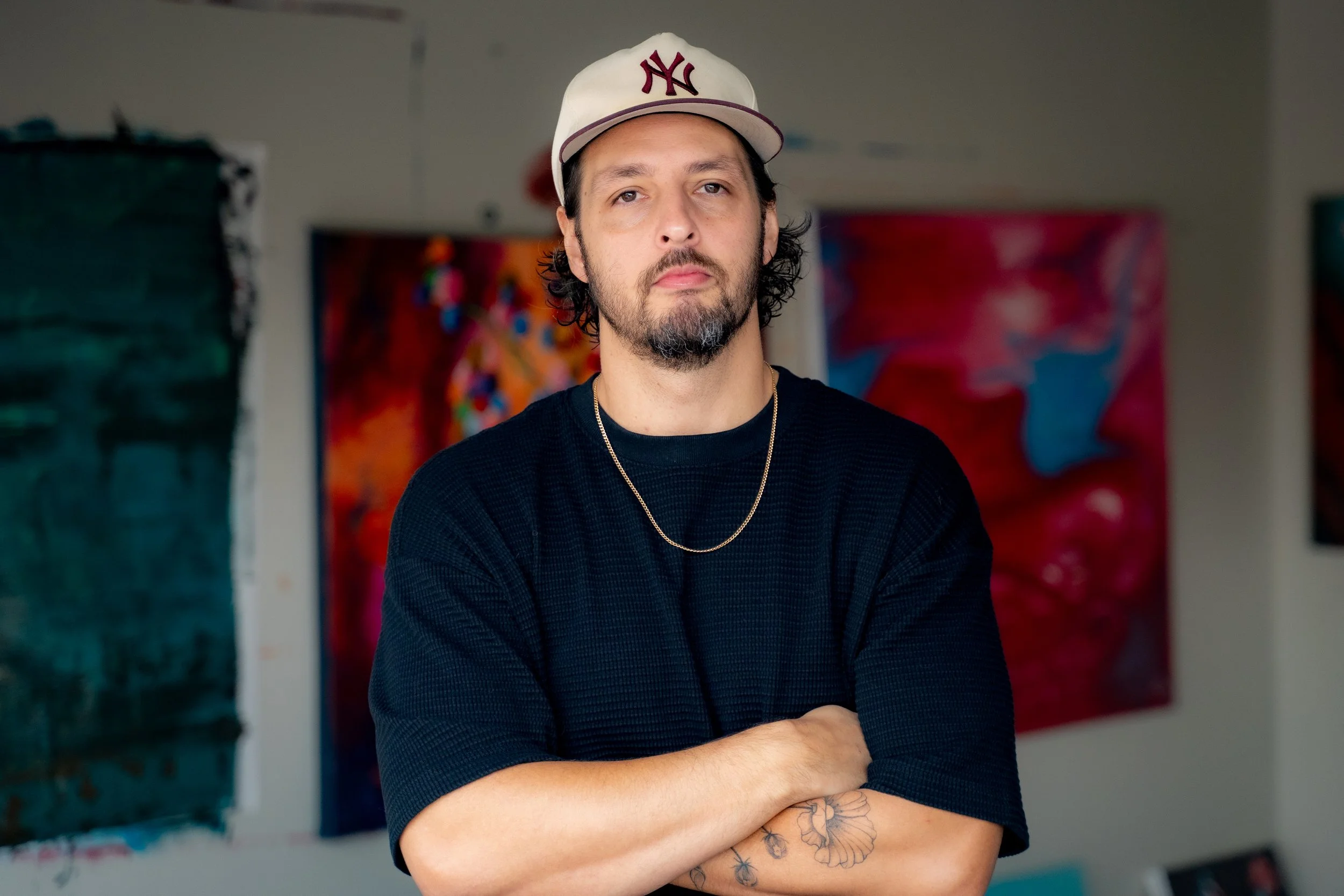
Jim Ewing
-Born: 1988 - New Jersey, USA
A painter and sculptor based in Southern California who works from his home studio in Cathedral City, California. A self-directed artist, he developed his studio practice through independent study after more than fifteen years working across photography, cinematography, film, television, and post-production. His professional work has contributed to projects for CBS, Disney, DreamWorks, Paramount Pictures, MTV, BET, Viacom, and Sports Illustrated.
Ewing’s work has been exhibited in group shows at Untitled Gallery in Ontario, Flat Black in Palm Desert, and Sammy Zelcer Fine Art in Cathedral City. His practice examines pressure, containment, rupture, and transformation through distorted figures, biomorphic forms, painting, and sculpture. His current series, Torn, focuses on surfaces that split, stretch, peel, and open under force.
Artist Statement
My work explores pressure in its physical, emotional, and structural forms through oil paintings and sculptural works. It focuses on the moment when a surface can no longer remain unchanged. When it stretches, tears, compresses, cracks, or transforms under force.
Using plaster, pigment, canvas, and other constructed materials, I build surfaces in layers. I pull, bind, break, sand, carve, and reshape these materials, allowing buried colors and interior structures to become visible. Rather than illustrating pressure directly, I create conditions in which the material appears to experience it.
I am interested in pressure because it is one of the fundamental forces that shapes people. It can come from family, responsibility, loss, expectation, survival, or the weight of supporting others. Pressure can damage a form, but it can also redistribute weight, create resistance, and produce unexpected strength.
Through material transformation, my work asks what pressure makes a person, body, or structure become. The finished pieces exist as records of endurance: surfaces permanently changed by what they have been asked to hold.